
2026-10-28 · Jordan Hale
Energy Use Patterns For AC Units In Summerlin Neighborhoods
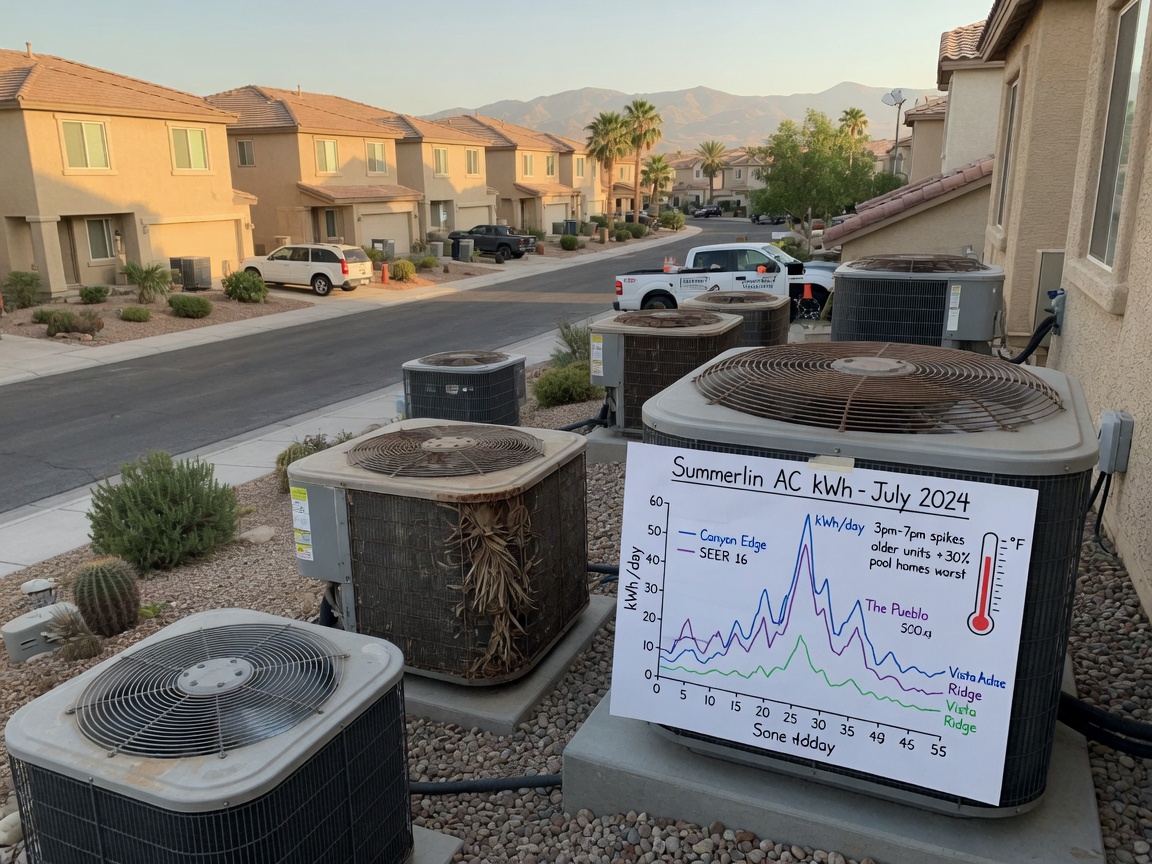
AC units serving Summerlin neighborhoods draw 30-50% more electricity from June through September than in shoulder months because daytime highs routinely exceed 105°F and nighttime lows rarely drop below 80°F. This sustained load pushes average 4-ton systems in 2,000-3,000 square foot single-family homes to 3,500-5,000 kWh per month during peak summer. Newer Summerlin developments built after 2005 often show 15-20% lower usage than 1990s stock due to better duct sealing and higher SEER ratings, yet older sections near the Red Rock Canyon edge still contend with greater infiltration from prevailing winds.
Summerlin Housing Stock and Baseline Loads
Most Summerlin homes are single-story ranch or two-story models with 12-18 SEER equipment installed between 1998 and 2018. Homes built before 2005 typically have R-19 attic insulation and older flex duct that leaks 20-30% of conditioned air, forcing compressors to run longer cycles. Newer tracts closer to Summerlin South feature spray-foam or R-38 batts and variable-speed units that cut runtime by 25-35% on 110°F days. Terrain matters too: properties on the western edge near Red Rock Canyon experience slightly lower afternoon heat gain from canyon shading, while eastern sections nearer the Las Vegas Strip absorb more reflected heat from surrounding pavement.
Thermostat settings average 76-78°F during occupied hours in Summerlin, yet many residents raise setpoints to 82°F when away, producing measurable 12-18% savings on monthly bills. Oversized units common in 3,000+ square foot homes short-cycle and waste 10-15% more energy than properly matched systems. Clark County building codes now require Manual J calculations, but legacy installations still dominate the older pockets of the neighborhood.
Climate-Driven Usage Spikes
Las Vegas hot desert conditions create two distinct daily peaks: a 4-7 PM surge when solar gain peaks and a secondary 10 PM-2 AM spike as thermal mass releases stored heat. During July and August, AC compressors in Summerlin can run 18-22 hours per day. Humidity stays low at 10-20%, so latent loads remain minimal, yet the sheer sensible load from 105-115°F outdoor temperatures dominates energy patterns. Residents near the High Roller and Sphere report slightly higher usage from urban heat island effects compared with homes closer to Centennial Hills.
Mild winters allow heat pumps to operate efficiently most of the year, but the summer pattern still accounts for 60-70% of annual kilowatt-hour consumption. When a heat wave pushes consecutive days above 110°F, daily energy draw can jump another 25% above already elevated baselines.
Maintenance Impact on Energy Patterns
Regular filter changes every 30 days in dusty Summerlin conditions keep static pressure low and preserve 8-12% efficiency. Neglected coils reduce heat transfer and add 15-20% runtime. Homeowners who schedule HVAC maintenance before June typically see steadier energy curves rather than sharp spikes once temperatures climb. Dirty blower motors or failing capacitors cause the same 10-15% energy penalty observed in repair data across Clark County.
Duct leakage tests in Summerlin homes frequently reveal 200-400 CFM of loss; sealing these returns 10-18% of wasted energy. Air conditioning repair calls for low refrigerant often trace back to the same efficiency losses that inflate summer bills.
When Patterns Signal Needed Repairs
Sudden 20%+ increases in monthly kWh without thermostat changes usually indicate a failing capacitor, low refrigerant, or clogged filter. Variable-speed systems in newer Summerlin homes show flatter energy curves until a component drifts out of calibration. Tracking usage against the prior year reveals problems earlier than waiting for complete failure.